Data coverage and quality
Every chart, match, study and backtest reads accepted prepared data: versioned bars built from the exchange's raw trades and accepted for use. The Data page is the authority on what is available today and on its quality. Opening it never starts a download or a rebuild.
On this page · 6 sections
The Data page
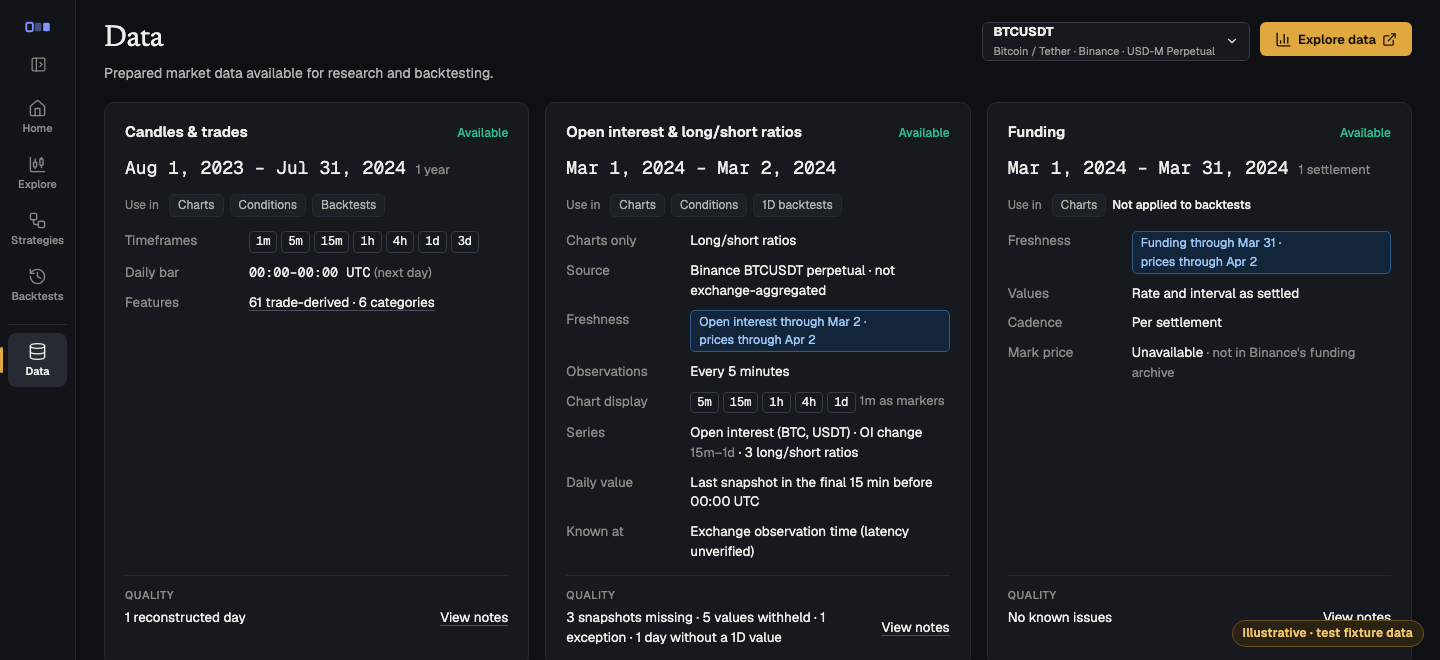
Choose Data in the navigation (under Source), then pick a market with the selector at the top. For that market it shows:
- a card for each dataset — Candles & trades, Open interest & long/short ratios and Funding — with its availability, covered date range, where you can use it (Use in: charts, conditions, backtests) and a Quality line;
- a blocking alert, only when a finding currently blocks research or backtests;
- three tabs below the cards: Data notes (each dataset's reconstructed days, acknowledged source discrepancies and open interest gaps, as tables), Features (what each dataset provides) and Technical (publication identifiers, versions and timeframe coverage).
View notes on a card opens that dataset's notes. The open tab is part of the page address, so you can bookmark or share it. The long/short ratios and funding are for charts only; open interest can also be used in conditions and daily backtests where that is enabled.
A clean window is quiet: no warning card, and each Quality line reads No known issues. Explore data opens Explore on that market's daily candles over the covered range.
What is available
| Supported today | |
|---|---|
| Market | Binance BTCUSDT USDⓈ-M perpetual futures |
| Chart candles in Explore | The prepared intervals listed on the Data page |
| Calculations, durations, Event Studies | Daily (1D) only |
| Strategies and Backtests | Daily (1D) only |
| Coverage | Shown on the Data page; it advances as each day is published and grows as older history is accepted |
A timeframe you can chart is not necessarily one you can research or trade: strategy and Event Study support is narrower than chart support. Data comes from Binance's published raw-trade archives, verified against their checksums — see Methodology › Data sources.
Daily bars and time
- A daily bar covers 00:00 to the next 00:00 UTC and is identified by its UTC start date (Oct 4, 2026 UTC), never shifted to your local day.
- A bar is complete only after its interval has ended and its data has been published, usually during the following day.
- Event times are shown in your browser's time zone; scheduled executions are always in ET.
Accepted publications
Accepted data advances as a sequence of publications. Each one is an immutable, identified version of the prepared bars. The pipeline is: raw exchange trades → prepared candles and features → an accepted publication with its data-quality metadata. Daily advancement and older-history additions each produce a new publication.
Research reads check that everything they combine — candles, calculated values, condition states, study outcomes — comes from the same publication. If accepted data changes while you work, the affected panel says the publication changed and offers Retry rather than mixing versions.
Reconstructed and excluded data
The exchange's source archive occasionally has an audited gap in its raw trades. The affected bar is then reconstructed: labeled Reconstructed with its UTC date and time window (the exact interval is in the label's tooltip), and recorded with the feature families it degrades. Reconstruction is never presented as clean data.
- A damaged feature family doesn't make every feature on that day invalid. For example, a reconstructed day can have degraded trade-count values while its close is still a valid price.
- Research excludes a day for a feature whose read window touches a degraded family (counted as Excluded in Matches), and a study fails closed when quality evidence for a reconstructed day can't be verified.
- Where a value can't be established, the product refuses or shows it as unknown. It never substitutes zero, a previous value, or an interpolation.
- Known source discrepancies appear in Data notes, and a backtest's report lists the notes of the data it pinned.
Pinned results and data corrections
- A Backtest records the publication it read when submitted and keeps it. A later correction or extension doesn't change it; its report says when its pinned data differs from current accepted data. That is provenance, not a defect.
- New research, studies and backtests always use the current accepted publication, so re-running an older idea can give different numbers.